
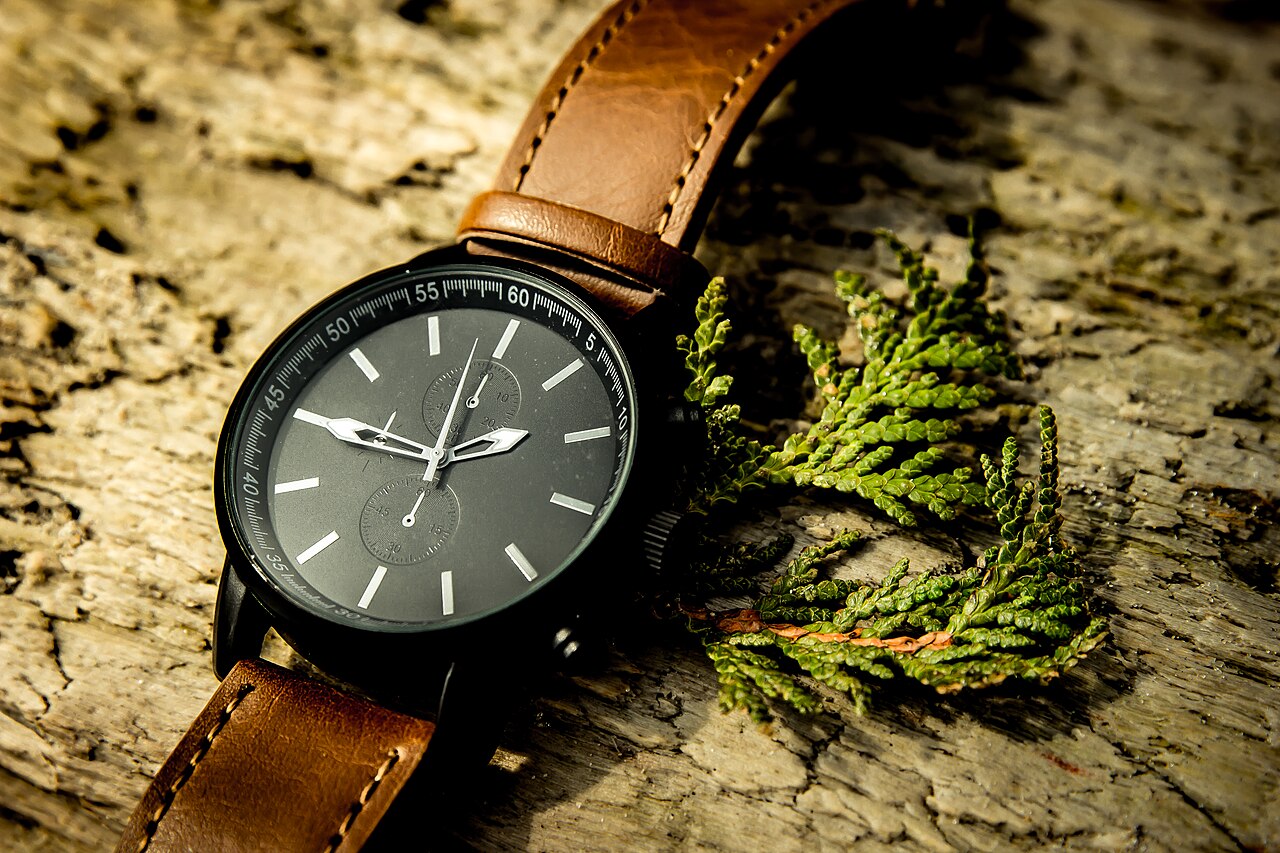
Swapping a watch strap takes minutes once you have the right parts. These checks cover the measurements, fittings and materials that decide whether the new strap actually works.
Quick look
- Strap width is measured between the inside edges of the lugs, in millimetres, and it is the number you need before ordering anything.
- The width is often printed on the underside of the old strap, and most modern watches use even sizes such as 18mm, 20mm or 22mm.
- Quick-release pins are tool-free but will not work on vintage watches with blind lugs, which need a standard bar and a spring bar tool.
- Measure your wrist where you wear the watch, add 10mm to 15mm for room, then check the fit with the two-finger rule.
- A water-resistance marking describes the watch case, not the strap, so check the strap maker’s guidance if the watch goes in water.
A watch strap is a small purchase that can go wrong in oddly specific ways. The wrong width will not seat between the lugs, a badly matched material can crack or smell by August, and a buckle that sits a few millimetres off will nag at your wrist all day. The fix is mostly measuring before you buy, then checking the fit properly once the strap is on. Work through this checklist with the watch face-down on a soft cloth.
Measure the lug width before you buy anything
- Look for the number on the old strap. Turn the watch over and check the underside of the strap near the case. Strap makers often print the width there in millimetres, which saves you measuring at all.
- Otherwise, measure the gap between the lugs. Lay the watch face-up on a soft surface, find the lugs (the two projections the strap attaches to) and measure the distance between their inside edges, exactly where the spring bar sits.
- Measure the inside, not the outside. Measuring across the outer edges of the lugs gives a larger number and a strap that will not seat.
- Do not buy by case size. A 40mm watch can take a 19mm, 20mm or 21mm strap depending on the model, so the case diameter tells you nothing useful about the strap you need. Case size is a separate measurement: men’s watches are typically 38mm to 45mm and women’s usually 35mm or less.
- Expect even numbers, but check anyway. Most modern watches use standard sizes such as 18mm, 20mm and 22mm, and odd widths do exist.
- Note the taper if you might change the buckle. Many straps narrow from the lug end to the buckle end, written as something like 20mm/18mm, which also changes how the strap sits.
Check how the strap attaches: spring bars and quick-release pins
Two systems do the same job, and the right one depends on your watch and how often you change straps.
| Question | Standard spring bar | Quick-release pin |
|---|---|---|
| How it releases | Tool presses the spring-loaded tip inward | A fingernail pulls a small lever or tab |
| Tools needed | Spring bar tool with a forked end and a flat end | None |
| Which lugs | Lugs with holes; the flat end of the tool suits blind lugs | Lugs with an external hole only |
| Suits | Vintage watches and watches worn in water | Frequent strap changes, or several straps for one watch |
- Holes in the lugs matter. Quick-release pins are not compatible with vintage watches that have blind lugs and no external hole, where a standard bar and the flat end of a tool are the only option.
- Do not treat lug width as proof of compatibility. A 20mm quick-release strap can still refuse to settle into a 20mm lug case, so check the attachment type as carefully as the measurement.
- Consider a fatter bar for a sports watch. Standard bars are commonly 1.5mm or 1.8mm in diameter, with fat versions of roughly 2.0mm to 2.5mm for watches that need greater retention. Quality bars of both types are designed to resist lateral forces of around 8 to 12 kg.
- Check both tips are seated. After fitting, look that both spring-bar tips sit in their holes and give the strap a gentle pull before wearing the watch.
Little trick: A spring bar tool costs very little, and the forked end is the one you will use most. Practise on the old strap before you touch a new one.
Match the strap material to daily wear and water exposure
- Start with where the watch actually goes. If it comes swimming, to the gym or into the shower, start with rubber, silicone or a NATO-style strap rather than leather.
- Expect rubber to feel different. Rubber straps have a break-in period and do not stretch the way leather does, so choose by measurement rather than by squeezing one on in a shop.
- Measure your wrist where you wear the watch. Wrap a soft tape just below the wrist bone. Standard strap lengths commonly suit wrists of about 6.5 to 8 inches, with short and long variants outside that.
- Add 10mm to 15mm for breathing room. That gives a target strap length rather than a single figure.
- Use the two-finger rule at fitting. Two fingers should slide under the fastened strap snugly without the watch shifting; three means too loose, one means too tight.
Look at the buckle and metal parts if your skin is sensitive
- Remember what sits against the skin. The buckle and any metal hardware press on the wrist for hours, so they deserve as much attention as the strap.
- Ask what the metal is before you order. If costume jewellery has made your skin sore before, apply the same caution here. Our guide to jewellery for sensitive skin explains nickel allergy basics and the materials people usually get on better with.
- Keep it clean. Sweat and soap residue collect under a buckle. Our guide to cleaning and storing everyday jewellery covers habits that work for watch hardware too.
- Check the buckle width if you plan to swap it. Listings sometimes quote the width at the buckle as well as the lug end. It only matters if you are replacing the buckle, in which case the two need to match.
- Think about the rest of the outfit. With the watch sorted, our guide to accessorising without overdoing it covers how to stop everything else competing with it.
Confirm what a water-resistance rating does and does not cover
- Read the rating as a claim about the case. A water-resistance marking describes the watch case, not the strap. A new strap neither adds to nor takes away from what the case is rated for.
- Check the strap maker’s guidance for water use. If you swim in the watch, look for a strap the maker lists for that kind of wear, and use a spring bar with enough retention.
- Keep leather for dry days. A leather strap that stays damp will not last as long, whatever the dial says.
- Get the fit checked if you swim. If the watch is rated for swimming and you are not confident the new strap is seated correctly, have someone qualified look at it before you get in the water.
Test the fit and check for rubbing before you trim anything
- Wear it at home first. Fasten the new strap and wear it indoors for an hour before you cut, punch or glue anything.
- Look for gaps at the lugs. The strap should sit flush between them. A wrong width leaves gaps or creates pressure points, which affects both comfort and appearance.
- Check where the buckle lands. A tapered strap usually sits more naturally under the clasp and spreads pressure more evenly, so if the buckle digs in, the taper or length is wrong for your wrist.
- Add holes reluctantly. Punching extra holes in a strap that is too long is possible, but not ideal. Order the shorter length if the maker offers one.
- Give a rubber strap time. Allow for its break-in period before deciding that anything needs shortening.
Keep the old strap, pins and tools for future changes
- Bag the old strap with its bars. Keep the spring bars with the strap they came off, labelled with the watch they fit.
- Keep the tool. A spring bar tool is inexpensive, and having one at home means a strap change does not wait for a shop visit.
- Write the measurements down. Note the lug width and your wrist measurement inside the watch box, so the next purchase starts with numbers you already have.
- Keep a spare bar. A spare costs very little and saves a watch from sitting in a drawer while you order one.
Ask away
Can I fit any strap to any watch?
Only if the width and the attachment type both match. The strap has to sit between the lugs, and a quick-release pin needs lugs with an external hole, so vintage watches with blind lugs need a standard spring bar.
How do I find my watch’s lug width?
Check the underside of the old strap first, because the width is often printed there in millimetres. If it is missing, measure the gap between the inside edges of the lugs where the spring bar sits.
Are quick-release straps as secure as standard spring bars?
The internal structure is much the same, and quality bars of either type are built to cope with similar lateral loads. The practical risk is a poor fit, so check both tips are seated and pull gently before wearing the watch.
What does a water-resistance rating cover after a strap change?
The rating refers to the watch case rather than the strap. If the watch is rated for swimming, choose a strap the maker lists for water use and have the fit checked if you are unsure.
This article is general information, not medical advice. For skin, scalp or allergy concerns, speak to a pharmacist, your GP or a dermatologist. In an emergency, call 999.